Romanticism and the Necessity of Moral Objectivity
The imperative for romanticism in the age of utility
Read the original on Substack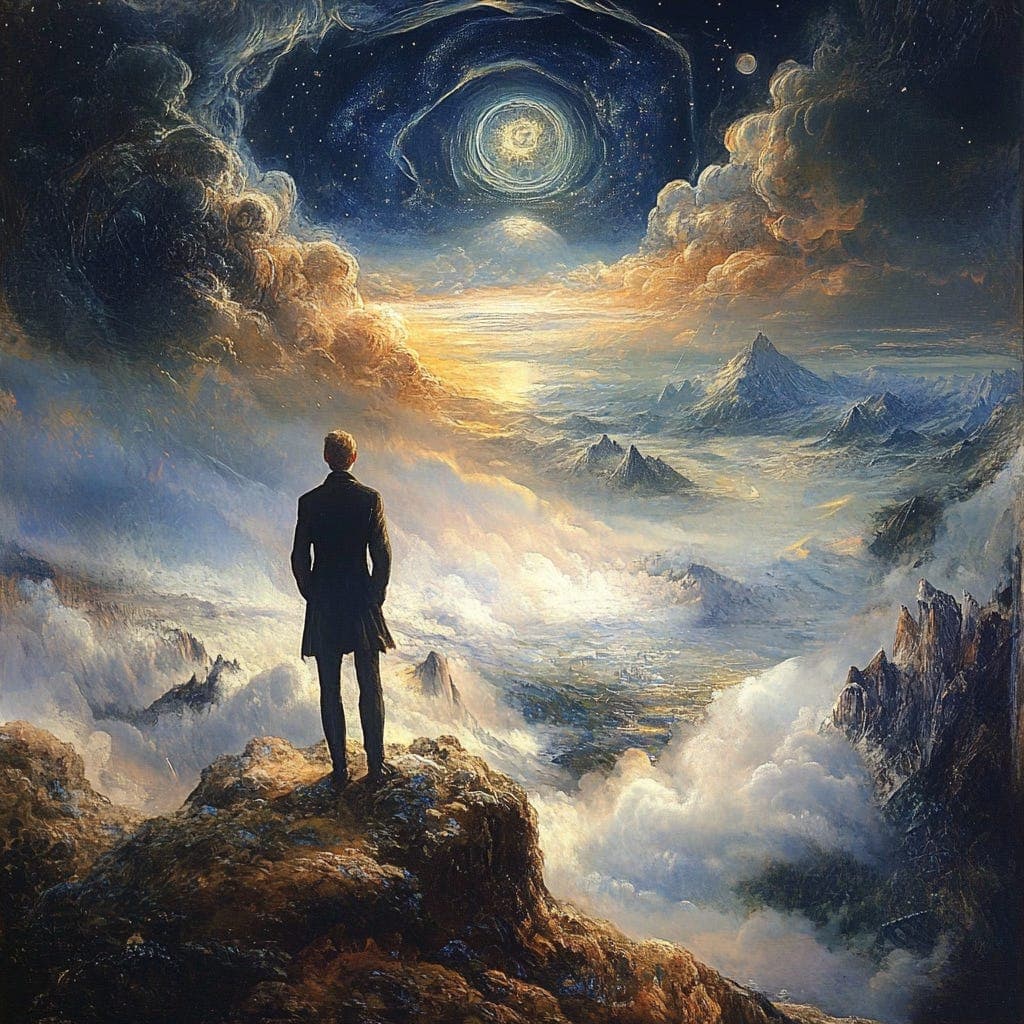
The prophet began orating in illustrious prose of the great many epiphanies that had bequeath him only to be stopped headlong in his tracks by the skeptical elder demanding he have something to show in-hand for all his prognostications. The cynic in all his resentment and twilight told the prophet, “Not once in my life had change ever manifested, let alone for a single fantasy once to have created itself onto reality. To think otherwise is to delude yourself into an apparition, for nothing has ever changed from the day I was birth, nor will anything ever change from the day after I die. All that there could ever be has already been, so let us humble ourselves down to what is important and immediately before us by keeping these pesky thoughts of ostentation to ourselves.”
The prophet winced as the words sent him into retreat for all the grandiose imagery festering in his mind began stumbling and stuttering within. The prophet was then reminded why he was so reticent to leave the cave where the imagined is inseparable from the apparent, for it was here in this cave where enlightenment was found through abject mania. A serene for where the most fleeting of intuitions transmuted into the most decisive of convictions, as the illusory and incomprehensible unite as one to illume the world afar and outside the cave.
The prophet then spoke “Am I not here in the flesh alongside you, can I only be held accountable for what I bear witness to that in hand.” The cynic told the prophet “Life is difficult enough as it is, thus to spend any more time thinking about it will only deepen the sting. Tell the people they’re going to suffer and toil but after long enough the pain will elapse, we need not purple tinged lies to make them hope otherwise.”. The prophet then told the cynic “Because thus has never been, means not that thus can never become. Why must we strangle faith before belief is ever given the opportunity to become? For your moontide may soon be coming to its end, lest we not bring end to the tide of morning dawn whose fate has yet to be sealed.” The words of the prophet echoed into the cynic, reverberating deep into his soul, as the elder listened and wanted to believe. He knew better to believe, but this rotting decrepit voice wanted him not to believe otherwise, but to unbelieve into nothingness. For the prophet did not come out from the cave into the world with a goblet of fire in hand to convince even the most ardent of unbelievers, but it was his spirit, vigor, and love for life the world needed to feel, not the spectacle of the flames bouncing from base to brim into perpetuity.
From the moment consciousness was birth and introspection could commence, great discourse has emerged on the phenomenology of stimuli upon whether or not the external world is objectively real or simulated. Phenomena manifest teeters the mind between the apparent and intrinsic, separating visionaries from realists on whether objects are contiguous, formed of a universal whole or an amalgam of dissociated particulars. This debate has demarcated Platonism from Aristotelianism, romanticism from materialism, the will from determinism, and even economics along the dialectic of supply-side and demand-side economics.
Romanticism and Materialism
When the artist or visionary forges something into being, does that resultant object represent a novel form or is it a transmutation of pre-existing particulates taking on a new representation. The romantic believes this object is created, meaning the sum of the particles in isolation is not isomorphic to the newly emanated object. It is a belief that something has been objectivity created and it is not just a coincidental arrangement of matter. Thus by axiomatic contingency to believe something can be created necessitates that something can also be destroyed. What this means is that if said created object disintegrates, the final state of that former object is not solely a transmutation of the original particle(s), but rather the object has been destroyed in a metaphysical sense as the force and essence holding together the original emanation is no more. The irreversibility of the shattering of glass is faint evidence of this within the physical sciences that objects do in fact get “destroyed”, as the second law of thermodynamics states entropy must always increase within a closed system, thus any attempt to reassemble the shattered glass back into a single object would result into the creation of a new object. Only if entropy could remain unchanged within a closed system could we demonstrate objects perfectly transmute, however, physics tells us otherwise that assembling shattered glass back into a single whole necessitates more entropy than what was begun with.
Ultimately the romantic believes when an object is created it is manifest both physically and metaphysically such that the physical permutation integrates upwards into the metaphysical dimension where objective creation and destruction is irreducibly explicit. In the same way the observer effect in the double-slit experiment changes the output particle distribution in the presence of measurement apparatus, is the same manner how the observer decides if the object is whole or an amalgamation of particulars. Such analogy for this is that observed phenomena can exist within a quantum superposition of opposing metaphysical states of existence and destruction, such that the output physical states can be a distribution between formed whole objects and granulated piecemeal ones until the observer intervenes thus deciding the final state.
Materialists on the other hand believe objects can be neither created or destroyed, rejecting the premise of a pre-existing “form” sharing any material continuity with the object in physical reality, thus concluding objects can only be rearranged into some particular formation but never fundamentally created from nothing into being. Following this logic, the possibility of creation is categorically denied for there can be no “thought” as an intermediary to the “forms”, thus anything seemingly “created” can only be downstream from some physical process. The Machiavellian cannot believe in an objective reality because there can be no higher-order universal interface to commune with, thus the perception of the self being perturbed by said particular forces can be the only litmus test for reality.
Subsequently, within materialism universal claims can’t be made, only crude approximations inferred via statistical averages between a summation of individual experiences validated loosely by apparent reproducibility. Between two distinct time points of the universe (past the moment of creation), the materialist must believe the total quantity of matter has remained unchanged, therefore even if there’s measurable change relative to an individual observer, in absolute terms change cannot exist. Any apparent change must be resultant of some physical reformation of brain matter stored as some set of electrical signals. Within these axioms, the space of all possible experiences already exists within the mind, therefore lending credibility to some permutation of the simulation hypothesis. The materialist cannot anticipate a future state, meaning an artist cannot anticipate the outcome of something envisioned in the future for the output experiential qualia of that perceived end state had already existed within the mind because fundamentally nothing can ever change nor can be created.
Demand-side and Supply-side economics
This same romantic materialist divide translates over to the dialogue between demand-side and supply-side economics. Demand side economics states that demand is innate, meaning human desires are mostly if not entirely predetermined and economic goods are created only to service those pre-existing desires. Demand-side economics loosely correlates to some permutation of biological-determinism in that economic demand is resultant of some innate biological primitive of instinct. This holds some truth as restaurants brand themselves in the color red to trigger a hunger instinct in the same way farm-raised salmon is artificially colored via its feed to coerce the subconscious into believing the food is nutritious and authentic. Within the boundary conditions of inelastic goods such as food or running water, demand-side economics is validated as there is an undue biological primitive governing actions demanding calories, comfort and warmth. While we can recognize some component of human behavior is governed by the necessity of biological subsistence, not all human behavior is determined by instinct.
Supply-side economics enters the conversation for describing demand of economic goods that are not determined by a biological primitive. When Steve Jobs created the iPhone, it was not abundantly clear that a product synthesizing the functionality of the cellphone, mp3 player, and GPS was going to result into a product with any demand since the functionality already existed within three separate product categories. While the end product did combine those product categories, what actually happened was that the novel product category of the smartphone was created, as the iPhone enabled an ecosystem of products and services via the App Store that could not have existed before the iPhone. What happened here is that the visionary envisioned both a product and an ecosystem, creating a solution to a problem people didn’t realize existed in the form of the smartphone.
This leaves us with a very important question, was demand for this new product category of the smartphone created by its supply? Meaning, had this object not been created would this desire to own this object ever have manifested? The materialist will tell you, this desire was always innate and was waiting to be serviced by the uncreated product or service while the romantic will tell you no, this demand was actually created and would not have existed without this object ever coming into being. Fundamentally the materialist credits biology for the experience while the romantic credits the visionary for the experience.
Necessity for Moral Objectivity
However this discourse culminates into a greater question, if the romantic hypothesis is correct that objects can objectively be created or destroyed, this necessitates that your actions objectively invoke change into the world alongside the assumption that the good cultivates and evil destroys. If you create something that enables a negative pattern, or rather what was created has brought harm, ill, and destruction into the world, maybe said object ought not ever have been brought into being. The romantic would have to believe that there exists some objective moral assignment to an economic good like porn, while the materialist would reject assigning any moral value to something like porn because all possible experiential references exists before said experience is manifest because phenomena is downstream from some physical process as nothing is ever created nor destroyed. You can then describe life and death simply as a cyclical simulation pruning data out from memory into storage and vice versa, ad nauseum and into perpetuity. This is not to say that when an object is created, the progenitor of the object then determines the outcome of other agents solely by exposure to said object following some permutation of environmental determinism, but if we are to assume the will is indeterminate there must be moral objectivity that there exists the best way something can be done aligning people towards some universal reference frame, in short the incontestable existence of the good.
If materialism is assumed true, there exists no fundamental reason for the will to exist if the actions one does are uncorrelated from the perceived results of those actions. Without believing new objects can take shape and manifest, all possible states of self-reference exist within you for nothing objectively is created nor destroyed. Anything before your eyes is not novel but a provocation of an internal state, thus good or evil cannot be objective things existing before you but only as a proportion of an internal equilibrium. This leads us to a world where the scientist cannot use intuition to validate if scientific data appears reasonable for empiricism, the amalgamation of phenomenological measurements must always take precedent over any individual judgement. Artistic analysis through materialistic prerogatives paves the way for adages like “good artists copy, great artists steal” because it’s assumed the artist does in fact not create art but rather is solely resultant of their prior experiences. The dialogue then converges to what prior art said artist consumed and how the culmination of their external stimuli influenced the output of their biological hardware manifest as art. This framing is profoundly nihilistic and takes away any notions of human accomplishment. This renders all athletes as basically being born into greatness regardless of any hurdles and setbacks they faced along their journey to the top. In this purported world we could not hold Alexander the Great in high honors because it was not him doing the “conquering” but rather it was an exercise of coincidence where he exercised the opportunity afforded to him as the son of King Phillip whom had an army at his disposal waiting to be deployed.
The Will and Determinism
As we’ve set the stage for why romanticism necessitates moral objectivity, all of this theorizing against materialism would be for nothing if the will is illusory and objectively does not exist.
In a world without the will meaning must converge solely to measure. Because time cannot be reversed nor can the beginning of the universe be reinitiated, statistics is used as the methodological blanket for estimating the boundary conditions of what might be valid due to the fundamental limitations of measure. While statistics might be a useful technique for associating patterns and extrapolating correlations relative to mechanistic cause, in terms of meaning it is epistemically bankrupt.
This same belief in mechanistic output has emboldened the determinists of our epoch into committing a grave categorical error by falsely proclaiming consciousness can be mechanically constructed through a statistical process via the LLM and or some future iteration of AI technology. Irrespective of how cogent the words of an LLM might come across as, intuitively it can be felt there’s no soul behind the words in the same manner how statistics removes intent and the will from its calculations. Ultimately it’s a statistical approximation of language as language itself is an imperfect medium for transmitting one’s internal conscious state from one human to another.
This assumption has resulted into the mechanistic interpretability of language as a race to the bottom towards identifying these linguistic primitives. This same sentiment has animated modern writing almost perfectly, for if the words cannot be understood by everyone in no more than a moment’s flick-of-the-finger, then the words are to be rendered insolvent as null-and-void.
Modern writing circumvents the command and intent of language by eliciting of a tone tainted in sardonicism and irony, thus resulting in a sterility equal in proportion to our plastic agriculture where each fruit is a genetic copy of the other without a mark or blemish in sight. Rather than quenching you with animus and purpose, modern writing is like urine masquerading as lemonade, dehydrating you of your resolve every sip you take. Modern writing surrogates initiative for coincidence, as it attempts to imitate the nonchalant serendipity of base reality, but ultimately only titillating you into a state of anti-reality as a third-person observer.
As determinism strips you whole of intent, modern writing does the same by shrugging at you saying, “I don’t know but we’re all just here and it’s kind of a vibe so let it flow.” Thus, as we stop taking ownership over the words we write and let the words begin to command us instead, bigger problems then begin to ensue.
Without the will there can be no notion of the self neither the individual, for there can no irreducible unit of personhood, thus subsequently there can’t exist a legal system as people are no more individual persons where agency can attributed to any single person. Within this world wrongdoings can only be attributed to some proportion of biological determinism and or environmental determinism that reduce down to the primitives of genetic and societal processes.
Determinism doesn’t explain why people with copious material wealth would ever commit suicide, neither does it explain why there exists a contingency of men who would be happier and more spiritually at ease in a foxhole than live their entire lives in rhythm of the techno-capital machine. Determinism cannot explain the undue disgust of what the visionary and artist feels when they’re unable to birth their conception into the world, for if indeed there is a supernatural order in the world, the friction faced in manifesting said vision into being feels like a wrong being committed against that order. Anyone that’s felt this intuitively knows we’re not just atoms vacuously colliding into each other drifting away into the ether of space.
We also have to wonder why science has been possible if every fleeting moment is subject to more entropy than the other, thus increasing the total possible orientations of matter into magnitudes beyond measure. How could any measurement be made valid if any succeeding moment would then nullify the prior preceding one?
Even with all the faith put into measure, quantum physics reminded us that through the discovery of discrete “quantized” states that the qualia of lived experience cannot be arbitrary whilst affirming the indeterminacy of the universe through the Heisenberg uncertainty principle thus validating the will. Through man’s uncanny and the even greater uncanny of the universe, we can conclude that both meaning and the will are here to stay for eternity.
The Role of The Romantic
Moral objectively seems to be contingent on whether or not the world is real and if objects can be either created or destroyed rather than solely transmuted. It would logically follow that what which is evil brings destruction and tumult into the world and to describe destruction as an amoral transmutation only lends great aid to the forces of evil in this world. If there can only be material transmutation then economic goods like porn can only be market failures of disproportional natural processes rather than moral privation fomenting spiritual decay and degradation.
If the materialists had their way in the absolute, there would’ve never been any reason for cultural goods like art, cinema, or aesthetic architecture to ever have been created for there can be no material justification for anything other than fulfilling immediate biological primitives of sustenance. This lends to a profoundly transactional world, one that is anathema to the romantic.
The role of the visionary is to supersede the immediacy of quid-pro-quo that governs most of background economic life and to remind people both ardent materialists and otherwise that an archetype of human exists that can believe in something without rhyme or reason whom are capable to commit themselves to something opulent in the abstract without any expectation of return. Without the visionary and his prognostications, man becomes indistinguishable from animal as it our ability to die for principle even at the expensive of one’s biological imperative that truly sets apart man from animal.
The romantic exists to summon meaning into the world irrespective of how decrepit and degenerate the rest of the physical world may appear to be. The romantic finds contiguous continuity to where the cynic finds dissociated particulars. The romantic must remind the wandering generality for when they default to adages like “things could always be worse” they override them by saying “but should always be better”. Even as the masses may try fading the blue out of their collective blood, the romantic finds means to make blue out of red for it takes no more than courage and intent for meaning to reign supreme once again.
The romantic exists to remind you without a great vision commanding your soul, you’ll be defined by the forces of history before you, swaying crest to trough as every other utterance either meaningful or otherwise will thrash you mercilessly into a malaise of dysphoria.
The romantic is both the beacon of light and meaning within the pit of despair whilst also being the canary in the coalmine for when evil decides to rob the world of light. In the same way the materialist believes matter must remain idempotent to change, is the same way the romantic must remain intransigent in their cause to the forces of ridicule, derision, skepticism and antagonism. The visionary is supposed to be possessed by their cause, it’s not supposed to be rewarded in ceremony and gratitude because the wandering generality of man defaults to instinct rather than uplift themselves into higher-order conscious states. The almost naive belief in belief of the romantic is supposed to reflect ugliness in those skeptical of romanticism and subsequently truth, beauty, and goodness, thus forcing them to introspect and reevaluate their assumptions that human behavior can only be transactional in nature.
It is only the resolute belief in belief that summons change into being, enabling one to take the leap of faith and emanate an origin node from nothing into being. Your actions matter, the world is not illusory, and life can be your canvas if you choose to make so. Let us not become slaves to ideologies of inhibition that exist only to punish us of our agency and volition. Let us aim for greatness and if we failed trying, it was better to have lived than never to have lived at all. The time to generate is now.
If you like my work feel free to give me a follow on Twitter/X